
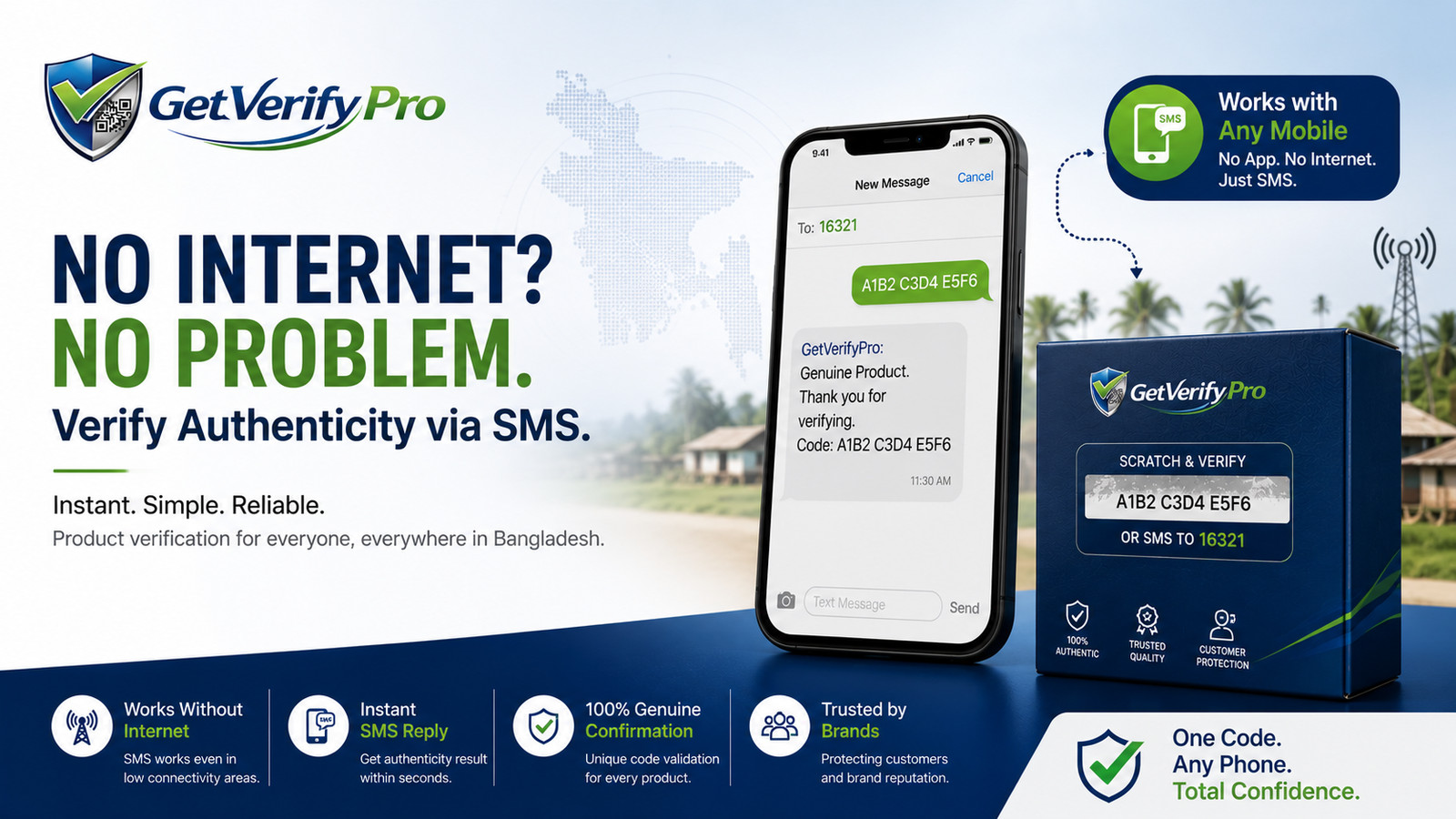
Most guides on product authentication assume one thing: that you have internet access to scan a QR code. But for a huge part of Bangladesh, that assumption simply doesn't hold. A mechanic in a small-town workshop, a shopkeeper in a rural market, or a customer buying engine oil in an area with weak mobile data coverage still deserves a way to confirm a product is genuine — and until recently, most verification systems left them with no option at all.
This is exactly the gap SMS verification is built to close. In this guide, we'll explain how to verify product authenticity without internet, why this matters so much in Bangladesh specifically, and how brands are using SMS-based systems alongside QR codes to make sure no customer is ever left unable to check what they're buying.
Visit GetVerifyPro Website: www.getverifypro.com
Visit Appnexaa Website For Product Details: www.appnexaa.com
Bangladesh has made real progress in mobile connectivity, but a significant gap still exists between how much of the country is actually online. Recent national data shows that just over half of the population uses the internet at all, and the gap between urban and rural access remains wide — rural users are considerably less likely to have reliable mobile internet than people living in cities, and digital literacy in rural areas lags even further behind.
For a product authentication system, this isn't a minor technical detail — it's the difference between a solution that protects everyone and a solution that quietly excludes a large share of the market. If a verification system only works with a QR code and a live internet connection, it fails exactly the customers who often need it most: people in smaller towns and rural markets, where counterfeit products are frequently sold with the least oversight.
SMS verification is built around a simple idea: every genuine product gets a unique code, and checking that code shouldn't require anything more than a basic mobile phone with signal. Here's the process, step by step:
No app to download. No data connection needed. No smartphone required. Just a text message and an instant answer — which is exactly why this method works in places where QR-only systems fall short.
Visit GetVerifyPro Website: www.getverifypro.com
Visit Appnexaa Website For Product Details: www.appnexaa.com
It's tempting to think of SMS verification as a fallback for when QR scanning isn't available. In practice, for a market like Bangladesh, it deserves to be treated as a primary channel, not an afterthought — for a few clear reasons:
A customer without a smartphone, or with a smartphone but no active data plan at that moment, is completely unable to use QR verification. SMS works on the most basic handset still in wide use across the country.
Mobile data can be unreliable during peak hours or in areas with limited tower coverage, while basic SMS often continues to work reliably even when data connections are slow or interrupted.
Not every customer is comfortable scanning a QR code or navigating an app. Sending a text message is a familiar, low-friction action that almost every mobile phone user already knows how to do.
Brands whose products reach beyond Dhaka, Chattogram, and other major urban centers — which is most brands with real distribution networks — need a verification method that works as reliably in a rural market as it does in a city shop.
Relying on QR codes alone creates a coverage gap that brands often don't notice until it's already costing them:
Brands like AISIN Bangladesh and FaitoBD, both operating in markets where products move well beyond city limits, rely on verification systems that combine QR, scratch code, and SMS together — precisely so that geography and internet access never determine whether a customer can trust what they've bought.
Visit GetVerifyPro Website: www.getverifypro.com
Visit Appnexaa Wbsite For Product Details: www.appnexaa.com
Adding SMS verification alongside QR and scratch code options isn't a cost brands should think of as optional. It functions as an extension of a brand's actual market reach:
For any brand serious about protecting its reputation nationally — not just in Dhaka — SMS verification is one of the most cost-effective ways to close a gap that QR-only systems leave wide open.
GetVerifyPro builds SMS verification as a core part of its authentication platform, not an add-on, specifically because of how much of Bangladesh's market depends on it. This includes:
If your brand sells products in areas where internet access can't be guaranteed — which, for most brands operating nationally in Bangladesh, is a significant part of the market — SMS verification isn't optional infrastructure. It's the piece that makes your authentication system actually work for everyone.
How do I verify a product without internet access? Look for a unique code on the product's packaging and check whether the brand offers SMS-based verification. If it does, you can text the code to the number provided and receive an instant reply confirming whether the product is genuine.
Does SMS verification cost money to use? This depends on the brand's system and your mobile carrier's standard SMS rates. Many brands design their verification service to use minimal-cost, standard text messaging so it remains accessible to all customers.
Is SMS verification as reliable as QR code verification? Yes. Both methods check the same underlying unique code against the same database. The only difference is how the customer submits the code — by scanning or by text message — the authenticity check itself works the same way.
Can a brand use SMS verification without also using QR codes? Yes, though most brands offer both together so customers can choose the method that works best for their situation, whether that's a quick QR scan in an area with good signal or an SMS check where data access is limited.
Why don't more product verification systems in Bangladesh offer SMS as an option? Building reliable SMS verification requires integration with telecom short-code services and real-time database checks, which takes more setup than a QR-only system. Many providers skip it, which is exactly why it's a meaningful differentiator for brands that offer it.
Want your product to be verifiable by every customer, whether they're in Dhaka or a rural market with no internet access? Contact GetVerifyPro to set up QR, scratch code, and SMS verification for your brand.
Visit GetVerifyPro Website: www.getverifypro.com
Visit Appnexaa Website For Product Details: www.appnexaa.com
Complete Overview: How to Identify Fake Products in Bangladesh: The Complete Guide (2026) – A comprehensive guide on identifying fake goods across retail, FMCG, and consumer categories.
Automotive & Lubricants: How to Spot Fake Engine Oil in Bangladesh (2026) – Protect your vehicle engine from substandard and recycled counterfeit oils.
Auto Parts & Safety: 7 Ways to Spot Fake Auto Spare Parts in Bangladesh (2026) – Key indicators for verifying genuine vehicle spare parts and components.
Pharmaceuticals & Healthcare: How to Check Fake Medicine in BD (2026 Guide) – Critical verification methods to ensure prescription drugs and health supplements are genuine.
Cosmetics & Skincare: How to Stop Fake Cosmetics Duplicate in Bangladesh (2026 Guide) – How beauty importers and skincare brands eliminate replica products and toxic fakes.