
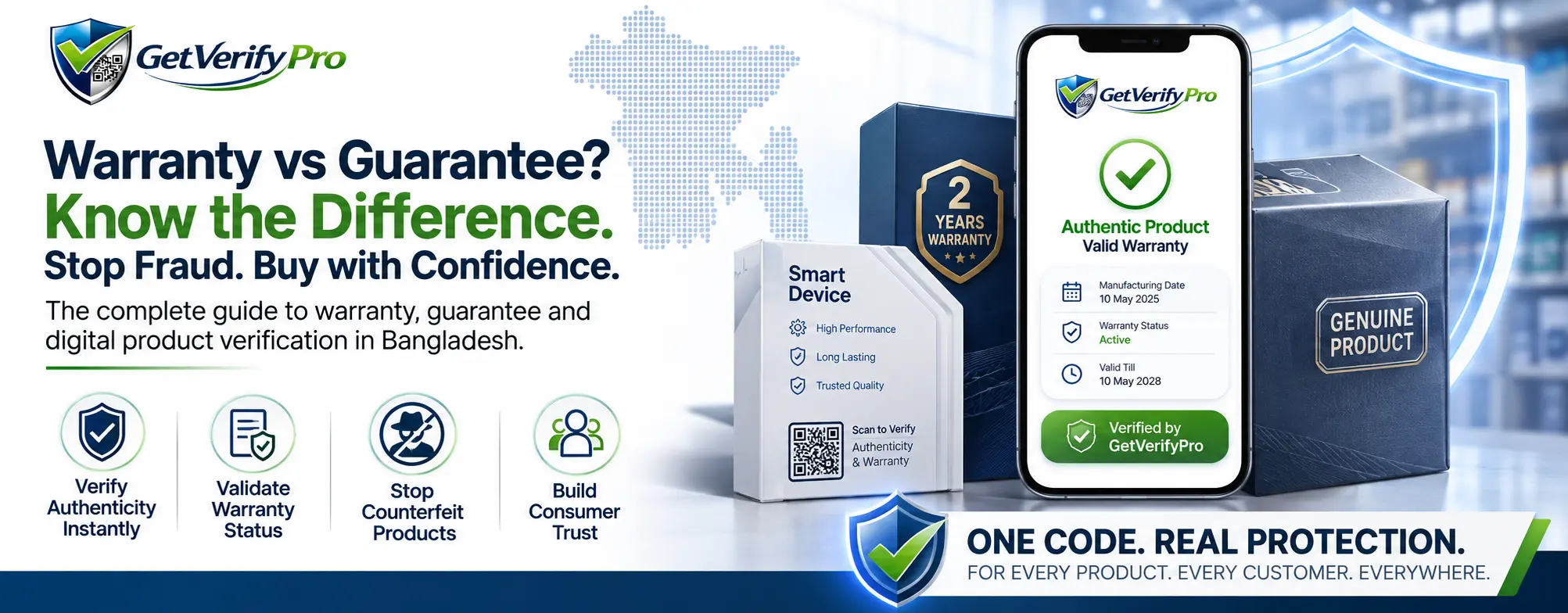
Every product sold in Bangladesh — from a mobile phone to a motorcycle battery to a kitchen blender — comes with some kind of promise attached to it. Sometimes that promise is called a warranty. Sometimes it's called a guarantee. Often, the shopkeeper, the customer, and even the brand use the two words interchangeably, and the paper card that's supposed to protect that promise fades, tears, or gets lost long before anyone actually needs to use it.
This guide covers everything — the real difference between warranty and guarantee, the types of warranty commonly used in Bangladesh, how warranty fraud actually happens here, and how digital verification technology is changing all of it. Whether you're a consumer trying to understand your rights or a brand manager trying to stop fraudulent claims from draining your service budget, this is the complete picture.
These two terms get used almost interchangeably in everyday conversation, but they mean different things legally and practically.
A warranty is a promise from the manufacturer or seller that a product will function as described for a specific period. If it fails due to a manufacturing defect within that period, the warranty typically covers repair, replacement, or parts — sometimes all three, sometimes only one, depending on the terms.
A guarantee is a broader assurance of quality or satisfaction, often tied to the product or service working as promised overall, and sometimes including a money-back option if it doesn't. A guarantee is more of a general confidence statement; a warranty is a more specific, terms-and-conditions-bound commitment.
In practice, in Bangladesh's retail market, both terms often appear on the same product packaging, and the specific coverage — what's included, what's excluded, and for how long — is usually spelled out on the warranty card or in the terms printed with the product. This is exactly why the physical warranty card matters so much, and why losing or damaging it has traditionally meant losing your ability to prove what you're entitled to.
Visit GetVerifyPro Website: www.getverifypro.com
Visit Appnexaa Website For Product Details: www.appnexaa.com
Understanding the type of warranty attached to a product matters, because it determines exactly what a customer can expect if something goes wrong.
Covers repair or replacement of the product at no cost during the warranty period, typically including both parts and labor.
Covers specific components or types of damage only — for example, covering the compressor of a refrigerator for an extended period while other parts are covered for a shorter standard period.
Covers replacement parts but not labor or service charges, meaning the customer may still pay for the technician's work even though the part itself is free.
An additional coverage period purchased separately, extending protection beyond the manufacturer's standard warranty window.
Focuses specifically on free servicing or maintenance visits during the covered period, separate from parts or full-product replacement coverage.
Most electronics and appliance brands operating in Bangladesh — Samsung, LG, Walton, and others — combine several of these types depending on the product category, which is exactly why the specific warranty card and its terms matter more than a general assumption of "it's under warranty."
Warranty fraud isn't a single problem — it's a cluster of related issues that all exploit the same underlying weakness: a paper-based, manually verified system with no central, tamper-proof record.
Thermal-paper receipts and printed warranty cards degrade over time — sometimes within months. By the time a genuine claim needs to be made, the purchase date or serial number may already be unreadable, leaving both the customer and the service center guessing.
A purchase date handwritten or printed on a card can be changed. Whether it's a customer trying to extend an expired warranty or a dealer backdating a sale to help a customer, an altered date is nearly impossible to detect once it's been done, since there's no independent record to compare it against.
A product that isn't genuine — a copy, a grey-market import, or a reused housing with fake internals — gets presented at a service center as if it were an authorized unit. Without a way to verify the product's actual manufacturing origin, staff are left making a judgment call, and brands often end up covering repair costs for products they never made or sold.
Serial numbers printed on paper or embossed on a product can be copied across multiple units, especially with counterfeit products. Each copy can then attempt to claim warranty service as if it were the original, and a paper-based system has no way to flag that the same serial number has already been used for a claim elsewhere.
Dealers sit between the brand and the customer and sometimes have their own incentives to bend the rules — extending warranty windows to close a sale, or filing claims for repairs that were never actually performed, particularly when the brand has no direct oversight of individual transactions.
Industry research on warranty fraud broadly (not specific to Bangladesh) puts fraudulent claims somewhere between 3% and 15% of total warranty claim volume, with the rate typically higher wherever authorized-channel checks are looser — a description that fits a large part of Bangladesh's multi-tier wholesaler-to-retailer distribution model closely.
Visit GetVerifyPro Website: www.getverifypro.com
Visit Appnexaa Website For Product Details: www.appnexaa.com
The core problem isn't that any single actor is dishonest — it's that a paper warranty card was never designed to be tamper-proof, individually trackable, or centrally verifiable. It's a static document that anyone with access to it can alter, lose, or reproduce, and once it leaves the brand's hands, there's no way to check its history against a central record.
This is true whether the fraud is intentional or accidental. A customer who genuinely lost their warranty card and a customer trying to extend an expired one look identical to a service technician holding an illegible piece of paper. The system doesn't just enable fraud — it makes honest verification difficult too.
Digital warranty management replaces the paper card with a system built around the same principle that makes modern product authentication work: give every unit a unique, verifiable, tamper-resistant identity.
Every product unit — not every batch, every individual unit — is assigned a unique QR code or scratch-off code at the point of manufacturing or import.
When the customer buys the product, they scan the code (or enter it via SMS if they don't have internet access), enter their phone number and the purchase date, and the warranty activates instantly. The activation timestamp is recorded automatically — there's no manual entry point for backdating.
When the product is brought in for a claim, staff scan the code and instantly see the warranty status, the manufacturing date, the activation date, and the complete claim history for that specific unit — replacing a faded paper card with a verified digital record.
If a code is scanned more times than expected, if it's already been activated elsewhere, or if a tampered or duplicated code is presented, the system flags it immediately — catching the attempt at the point it happens rather than after the cost has already been absorbed.
Customers without reliable internet access — a significant share of Bangladesh's market outside major cities — can register and check warranty status by texting their unique code to a designated number, keeping the entire system accessible regardless of connectivity.
| Paper Warranty Card | Digital QR/SMS Warranty | |
|---|---|---|
| Durability | Fades, tears, gets lost | Stored permanently, tied to the product |
| Date accuracy | Can be altered or backdated | Automatically timestamped at activation |
| Verification speed | Manual, error-prone | Instant, real-time database check |
| Counterfeit detection | No way to confirm origin | Flags unauthorized or duplicated units |
| Duplicate claim detection | None | Automatic, real-time alerts |
| Customer data capture | None — brand has no direct contact | Captured at activation, owned by the brand |
| Offline/rural access | Physical card works but is fragile | SMS registration works without internet |
| Dispute resolution | Word against word | Verifiable digital timestamp settles disputes |
| Claim history | Scattered or nonexistent | Complete record in one place |
While this guide is written largely for brands and importers, it's worth addressing the consumer side directly, since customer awareness affects how well any warranty system — paper or digital — actually functions:
Visit GetVerifyPro Website: www.getverifypro.com
Visit Appnexaa Website For Product Details: www.appnexaa.com
For brands and importers in Bangladesh, moving from paper to digital warranty management pays off in ways that extend well beyond simply catching fraud:
In a market where an estimated meaningful share of all warranty claims are fraudulent to some degree, the true cost of staying with paper isn't just the fraud itself — it's the absence of the customer data, dispute-resolution clarity, and brand trust that a digital system builds as a byproduct of simply solving the fraud problem.
GetVerifyPro provides the complete infrastructure described throughout this guide, purpose-built for Bangladesh's market conditions:
If your brand is still relying on paper warranty cards, the fraud, the disputes, and the missing customer data aren't separate problems — they're all symptoms of the same gap, and digital verification closes all of them at once.
Visit GetVerifyPro Website: www.getverifypro.com
Visit Appnexaa Website For Product Details: www.appnexaa.com
What is the difference between warranty and guarantee? A warranty is a specific, terms-bound promise to repair or replace a defective product within a set period. A guarantee is a broader assurance of quality or satisfaction, sometimes including a refund option. In practice, the exact coverage for either is defined by the terms printed on the product's warranty card.
How long does a typical warranty last in Bangladesh? This varies by product category and brand. Electronics and appliances commonly carry coverage ranging from six months for small accessories to several years for major components like refrigerator compressors, as specified on each product's individual warranty card.
Is a warranty card mandatory to claim a repair in Bangladesh? Most brands and service centers require either a valid warranty card or proof of purchase to process a claim. Products without valid registration or with altered, illegible documentation are typically considered outside warranty coverage.
How common is warranty fraud in Bangladesh? While there's no Bangladesh-specific published figure, broader industry research estimates fraudulent claims make up roughly 3% to 15% of total warranty claim volume, with higher rates typically occurring in markets with weaker authorized-channel verification — a pattern consistent with Bangladesh's multi-tier distribution system.
How does digital QR warranty verification actually stop fraud? Each unit is assigned a unique code activated once by the genuine buyer, with an automatic, unalterable timestamp. If the same code is presented again, or if a counterfeit unit attempts to register, the system flags it instantly instead of relying on manual inspection of a paper card.
Can customers in rural areas without internet access still use digital warranty registration? Yes. SMS-based registration allows customers to activate and verify warranty coverage by text message, so digital verification isn't limited to smartphone users or areas with reliable data access.
What happens if a dealer tries to backdate an invoice to extend a customer's warranty? In a digital system, the activation timestamp is generated automatically at the moment the customer registers the product, removing the manual entry point that makes backdating possible in paper-based systems.
Does digital warranty management work for products sold through multiple layers of wholesalers and dealers? Yes. Because activation happens directly between the brand's system and the end customer, the brand captures accurate ownership and warranty data regardless of how many distribution layers the product passed through beforehand.
Visit GetVerifyPro Website: www.getverifypro.com
Visit Appnexaa Website For Product Details: www.appnexaa.com
Ready to replace faded paper warranty cards with a verifiable digital system? Book a 1-on-1 demo with GetVerifyPro to see how digital warranty and guarantee management works for your brand.