
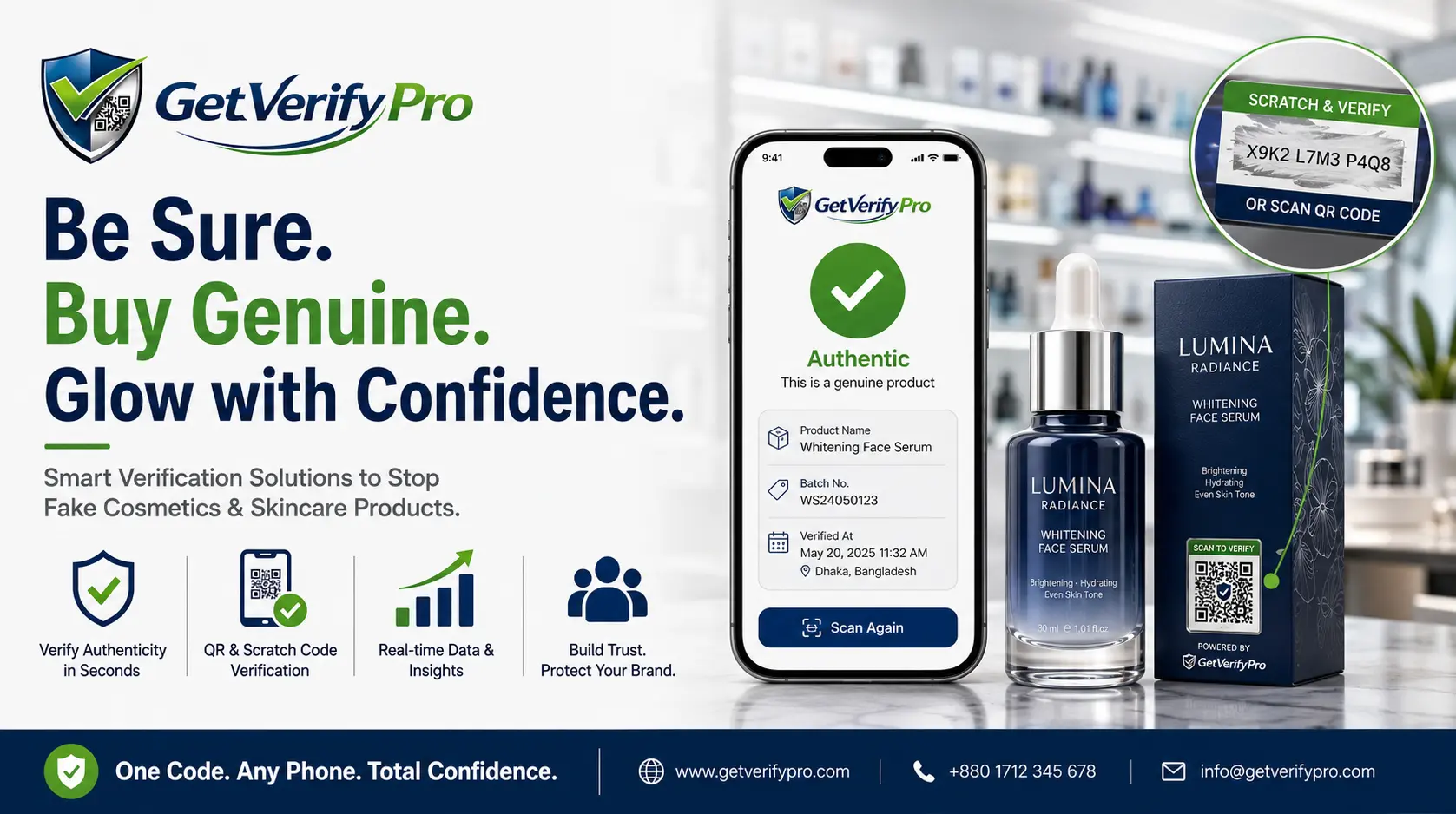
If you import or manufacture cosmetics and skincare products in Bangladesh, you've likely already run into this exact scenario: a customer messages your page asking if a product they bought from another seller is genuine, and you have no real way to answer with certainty. Multiply that by every reseller, every marketplace listing, and every unauthorized shop using your product photos — and the scale of the duplicate-product problem becomes clear.
This guide is written specifically for importers and local skincare brand owners in Bangladesh who are ready to move past generic advice like "check the packaging carefully" and actually put a system in place that stops duplicates before they cost you sales and trust. Here's how to stop fake cosmetics duplicates in Bangladesh, step by step.
Visit GetVerifyPro Website: www.getverifypro.com
Visit Appnexaa Website For Product Details: www.appnexaa.com
Before choosing a solution, it helps to know which of these three patterns is affecting your brand, since each one requires a slightly different response:
Most brands assume they're dealing with one of these when it's actually a mix of all three. This matters because a packaging redesign might reduce refilling, but it won't stop full counterfeit production — only individual-unit verification does that regardless of which method the duplicator is using.
Import and local brand owners often start by upgrading packaging quality — better print, holograms, tamper seals. These help, but they share the same fundamental weakness: once a counterfeiter has a genuine sample, they can replicate almost anything printed or embossed on it. A hologram sticker can be copied. A batch code can be photographed and reprinted. A tamper seal can be reproduced closely enough that most customers won't notice the difference.
Packaging upgrades slow down low-effort duplicators. They don't stop a determined one, and they give you no way to actually detect when a duplicate has been sold, where, or how many times.
This is the step that actually closes the gap packaging alone can't. Instead of trying to make packaging harder to copy, unit-level verification makes copying pointless — because each genuine unit carries a code that can't be validly reused, no matter how well the physical packaging is replicated.
In practice, this means:
For importers specifically, this also solves a distribution-visibility problem: you can see which codes are being verified in which locations, which helps identify where unauthorized resellers or grey-market channels are moving your product.
A common mistake is implementing QR-only verification and assuming that's sufficient. For a market like Bangladesh, where internet access and smartphone usage vary significantly between Dhaka and smaller towns, that leaves a real gap:
Offering all three means no part of your distribution network — urban retailer, rural reseller, or online customer — is left without a way to verify authenticity.
Once a verification system is in place, the real operational value comes from what you do with duplicate-scan alerts. When a code is verified more than once, that's a direct signal worth investigating:
This turns verification from a passive customer-facing feature into an active tool for protecting your distribution network.
For importers and brand owners competing in Bangladesh's cosmetics market, the ability to say "every unit of our product is individually verifiable" is a direct trust signal, not just a technical feature. This matters especially for:
Highlighting your verification system on packaging, product pages, and marketing materials turns a backend anti-fraud tool into a frontend sales advantage.
Visit GetVerifyPro Website: www.getverifypro.com
Visit Appnexaa Website For Product Details: www.appnexaa.com
For cosmetics importers and brand owners who continue relying on packaging alone, the cost tends to show up gradually and then all at once:
GetVerifyPro provides the complete verification infrastructure described in this guide, built for exactly this use case:
If you're an importer or brand owner tired of guessing whether duplicates are eating into your sales, this is the system that replaces the guessing with data — and gives your customers a real answer instead of a promise printed on the box.
Visit GetVerifyPro Website: www.getverifypro.com
Visit Appnexaa Website For Product Details: www.appnexaa.com
How can I tell if my cosmetics products are being duplicated in the market? Without a verification system, you typically only find out through customer complaints or by noticing unauthorized sellers offering your product at unusual prices. A unit-level verification system with duplicate-scan alerts identifies this in real time instead.
Is packaging redesign enough to stop counterfeit cosmetics? It can reduce low-effort duplication like refilling, but determined counterfeiters can replicate most printed and embossed packaging features. Unit-level digital verification is the only method that makes replication ineffective regardless of packaging quality.
What's the difference between counterfeit products and grey-market duplicates? Counterfeit products are unauthorized replicas manufactured to imitate your brand. Grey-market duplicates are genuine products sold outside your authorized distribution channels, sometimes mixed with actual counterfeits in the same shipment.
Do I need QR, scratch code, and SMS verification, or is one enough? Offering all three ensures coverage across your entire customer base, including areas with limited internet access. Relying on only one method typically leaves part of your market unable to verify products.
How quickly can duplicate scan alerts help identify a problem? Detection happens the moment a code is scanned a second time, allowing brands to investigate and respond immediately rather than discovering the problem weeks or months later through declining sales or customer complaints.
Ready to stop guessing where your duplicates are coming from? Contact GetVerifyPro to set up unit-level QR, scratch code, and SMS verification for your cosmetics brand.
Complete Overview: How to Identify Fake Products in Bangladesh: The Complete Guide (2026) – A comprehensive guide on identifying fake goods across retail, FMCG, and consumer categories.
Automotive & Lubricants: How to Spot Fake Engine Oil in Bangladesh (2026) – Protect your vehicle engine from substandard and recycled counterfeit oils.
Auto Parts & Safety: 7 Ways to Spot Fake Auto Spare Parts in Bangladesh (2026) – Key indicators for verifying genuine vehicle spare parts and components.
Pharmaceuticals & Healthcare: How to Check Fake Medicine in BD (2026 Guide) – Critical verification methods to ensure prescription drugs and health supplements are genuine.
Offline Security Technology: How to Verify Products Without Internet: SMS Verification Guide – Fast product authentication via scratch-off SMS codes for rural and offline users.